Which Delivers Better Performance?
Compaction is a crucial step in construction, landscaping, and paving projects. Whether preparing a base for concrete, asphalt, or pavers, the right compaction equipment ensures stability, durability, and long-term performance. Two of the most commonly used machines are walk-behind plate compactors and reversible plate compactors.
While both are designed to compact soil and aggregate, they differ significantly in power, maneuverability, and ideal applications. Understanding these differences will help you choose the right equipment for your jobsite.
What Is a Walk-Behind Plate Compactor?
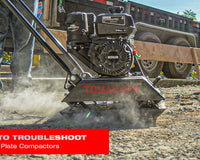
A walk-behind plate compactor is a forward-moving machine designed for compacting granular soils such as sand, gravel, and asphalt. It operates by vibrating a flat steel plate that presses down on the surface, increasing soil density.
These compactors are typically lightweight, easy to operate, and ideal for smaller jobs. They are commonly used for residential projects like patios, walkways, driveways, and light landscaping work.
Because they move in a single forward direction, operators guide the machine across the surface in passes to achieve the desired compaction.
What Is a Reversible Plate Compactor?
A reversible plate compactor is a more powerful machine that can move both forward and backward. This bidirectional capability allows for greater control and efficiency, especially on larger or more demanding jobs.
Reversible compactors are designed for heavier-duty applications, including compacting thicker layers of soil, cohesive materials, and larger jobsite areas. They are often used in roadwork, commercial construction, and foundation preparation.
These machines typically generate higher compaction force, making them more effective for deeper and more challenging compaction tasks.
Key Differences Between Walk-Behind and Reversible Plate Compactors
The most significant difference is direction control. Walk-behind compactors move only forward, while reversible compactors can move in both directions. This allows reversible models to work more efficiently in confined areas and reduce the need for repositioning.
Compaction force is another major factor. Reversible compactors generally deliver higher centrifugal force, enabling them to compact thicker layers and more demanding soil types. Walk-behind compactors are better suited for lighter-duty applications.
Productivity also varies. Reversible compactors can cover large areas faster due to their power and maneuverability. Walk-behind models, while effective, may require more passes and time on bigger projects.
In terms of size and weight, walk-behind compactors are lighter and easier to transport. Reversible compactors are heavier and may require more effort to move but offer greater performance.
Performance and Application Differences
Walk-behind plate compactors perform best on granular soils and thin layers. They are ideal for finishing work and smaller surfaces where precision and ease of use are important.
Reversible plate compactors excel in heavy-duty applications. Their ability to compact deeper layers makes them suitable for sub-base preparation, road construction, and large-scale projects.
Additionally, reversible compactors are more effective in tight or confined spaces where frequent directional changes are required.
When to Use a Walk-Behind Plate Compactor
A walk-behind plate compactor is the right choice for:
-
Small to medium residential projects
-
Paver installation and landscaping
-
Asphalt patching and repair
-
Jobs requiring lightweight, portable equipment
They are especially useful for contractors who need a reliable, easy-to-use machine for everyday tasks.
When to Use a Reversible Plate Compactor
A reversible plate compactor is best suited for:
-
Large construction or commercial projects
-
Deep compaction requirements
-
Cohesive or mixed soil types
-
Jobs requiring high efficiency and power
They are ideal for professionals who need maximum performance and versatility on demanding jobsites.
Cost and Efficiency Considerations
Walk-behind compactors are generally more affordable and have lower operating costs, making them a practical choice for smaller jobs or occasional use.
Reversible compactors require a higher initial investment but offer greater productivity and efficiency for large-scale projects. Over time, the increased performance can lead to significant labor savings.
Choosing between the two often depends on how frequently the equipment will be used and the scale of the projects.
Which Compactor Is Right for Your Job?
The decision between a walk-behind plate compactor and a reversible plate compactor comes down to project size, soil conditions, and performance requirements.
For smaller, lighter-duty tasks, a walk-behind compactor provides simplicity and reliability. For larger, more demanding applications, a reversible compactor delivers the power and efficiency needed to get the job done faster.
In many cases, contractors benefit from having both options available. Walk-behind compactors handle detail work and smaller areas, while reversible compactors take on heavy-duty compaction and larger surfaces.
By selecting the right equipment, you can improve jobsite efficiency, achieve better compaction results, and ensure long-lasting project performance.